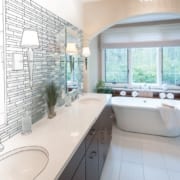
Bathroom Renovation Image

Bathroom renovations are the second most popular home renovation project today. So, where do you begin? What’s your motivation behind wanting to remodel your bathroom? Renovating a bathroom adds value to the home, but value creation is only one of the reasons our clients renovate their bathrooms. They want to make a personal design statement. They want a refuge in their home that they can use to relax in a stress-free environment. They also crave and appreciate a stylish and beautiful space.

According to the 2016 Houzz Bathroom Trends Study, the hot trends in bath renovations include beautiful, stylish spaces, luxurious finishes, and big showers.

Nationally more than 50% of homeowners do not bathe in the tub in their master bath. If you are considering a bathroom renovation ask yourself if you replaced your existing tub, would you bathe in a new one? If the answer is no, you add both flexibility to your space and your budget to invest in other areas, such as a “power shower” – a hot new trend. The most popular “power shower” features that homeowners add during a renovation include:

  • Rainfall showerhead (54%)
  • Dual shower (21%)
  • Curbless shower (17%)
  • Body sprays (16%)
  • Footrest (13%)
  • Steam (2%)

Houzz data shows that 68% of homeowners renovating their master baths increase the size of their shower and 33% increased shower space by more than 50%. Showers have also become high-tech, offering options like mood lighting, built-in sound, digital controls, LED lighting built into showerheads and showerheads with speakers.

Beyond the shower, the most common flooring materials used in recently renovated master baths include ceramic or porcelain tile, followed by stone tile or slabs, painted wood, stained or unstained hardwood, vinyl and laminate.

Paint and ceramic/porcelain tile are the top choices for wall coverings followed by stone tile or slab, painted wood panels, stained or unstained hardwood and wallpaper.

Similar to showers, today’s toilets have also gone high-tech. Twenty percent of toilets installed in renovated baths have high-tech features such as:

  • Self-cleaning systems
  • Overflow protection
  • Motion-activated toilet seats
  • Built-in night lights
  • Heated seats
  • Automatic deodorizer
  • Hands-free flushing

Ready to consider a bathroom remodel? We welcome the opportunity to help you create a stylish and beautiful space in your home that you can enjoy every day. Give us a call at 401-463-1550 or visit our Design Center at 139 Jefferson Boulevard, Warwick, RI to see how we can make your dream bath a reality.
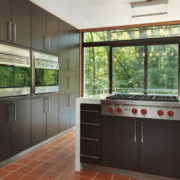
Modern Kitchen

Modern design is an exciting hot trend that speaks to many of our clients that want bright open spaces. When we design a modern kitchen, our client benefits from our efforts by selecting meaningful fixtures, cabinets, appliances and other components in a strategic way that results in clean space with minimal clutter.

Modern design often calls for doing more with less. It requires observations and innovation and is an exciting option! Some characteristics of modern kitchen and bath design are listed below.  If any of these characteristics appeal to your style and dreams, give us a call at 401-463-1550 or visit our Design Center at 139 Jefferson Boulevard, Warwick, RI 02888.

  • Clean lines
  • Bright open spaces
  • Minimalistic
  • Streamlined appliances
  • Genuinely curated objects that personalize a space
  • The intersection of form and function
  • Purposeful and aesthetically driven
  • Simple, authentic, uncomplicated and timeless
  • Everything you need and not more
  • Understated elegance
  • Neutral color palettes
  • A room that is tactile, fresh, alluring and inviting
  • Functional and stylish
  • Combining materials, textures and styles to produce a comfortable room that is both polished and finely curated
  • Open-minded and curious
  • Authentic and optimistic
  • Chic without the appearance of effort
  • Curious, courageous and confident
  • New ideas, materials, textures that inspire

Kitchen RemodelTo help you prepare to renovate your kitchen, reduce your anxiety and familiarize yourself with a kitchen makeover process, RIKB typically uses a five-step approach to any kitchen remodel. You’ll quickly realize that we’re obsessed with every detail.
Step 1 is the initial meeting in our Design Center. Our expert design consultants want to get to know you, what you like, what you want and what you need. We want to understand your lifestyle, the number of family members who use the kitchen and to what degree, how much you cook and entertain, your appliance preferences, shopping habits, storage needs, timelines, investment and budget. We’ll review our process, tell you about our experience, the services we provide and what we do to make a remodel less stressful and more enjoyable. At this time, we’ll also schedule an at-home visit to measure, photograph and review conceptual ideas.

Step 2 is a visit to your home. We’ll start by measuring the space and reviewing your décor to help assure that the recommended style and materials will blend with the architectural details of your home. We’ll review your storage preferences and the types of appliances you need. This is a critical step because we can’t design space unless we know the size of the appliances you want. At this point we will discuss design concepts with you and establish a working budget.

Step 3 is a meeting in the Design Center. Here, we’ll present you with design concepts and review the scope of work we created based on the space, needs, desires and budgets discussed. We’ll work with you to adjust the scope based upon your needs. Our Project Development Agreement will outline selected concepts and budget, so you can move forward with design and product selections. We’ll present cabinet quality that matches your budget, storage features, countertop, lighting, molding details and hardware options. After you make your selections, we will discuss revisions that may be necessary based on the options you choose.

Step 4 is a meeting to review the design revisions and confirm details. We will go over a revised time line for when cabinets need to be ordered, the length of time for demolition and installation. Your concepts are transformed into detailed plans as we guide you through the myriad of product choices to truly customize your space. Explore everything from cabinetry, and countertops, to plumbing fixtures, flooring, lighting, accessories and more. Construction documents are finalized and then the fun begins!

Step 5 is building your new kitchen. At our Pre-Construction Meeting, you’ll be introduced to your professional installation team. We’ll review every detail with you so we’re all on the same page. All materials are ordered, received and inspected at our facility and then our team is ready to install! We will confirm the lead times involved, communicate to you adjustments to the construction timeline if any, and maintain a constant line of communication during installation to ensure that work is progressing smoothly and you are receiving the quality you expect and deserve.

We are confident that you’ll love our process almost as much as your new kitchen. If you have questions or would like additional information, please call us at 401-463-1550 or visit our Design Center 139 Jefferson Boulevard, Warwick, RI 02888.

Beige Tiled Backsplash

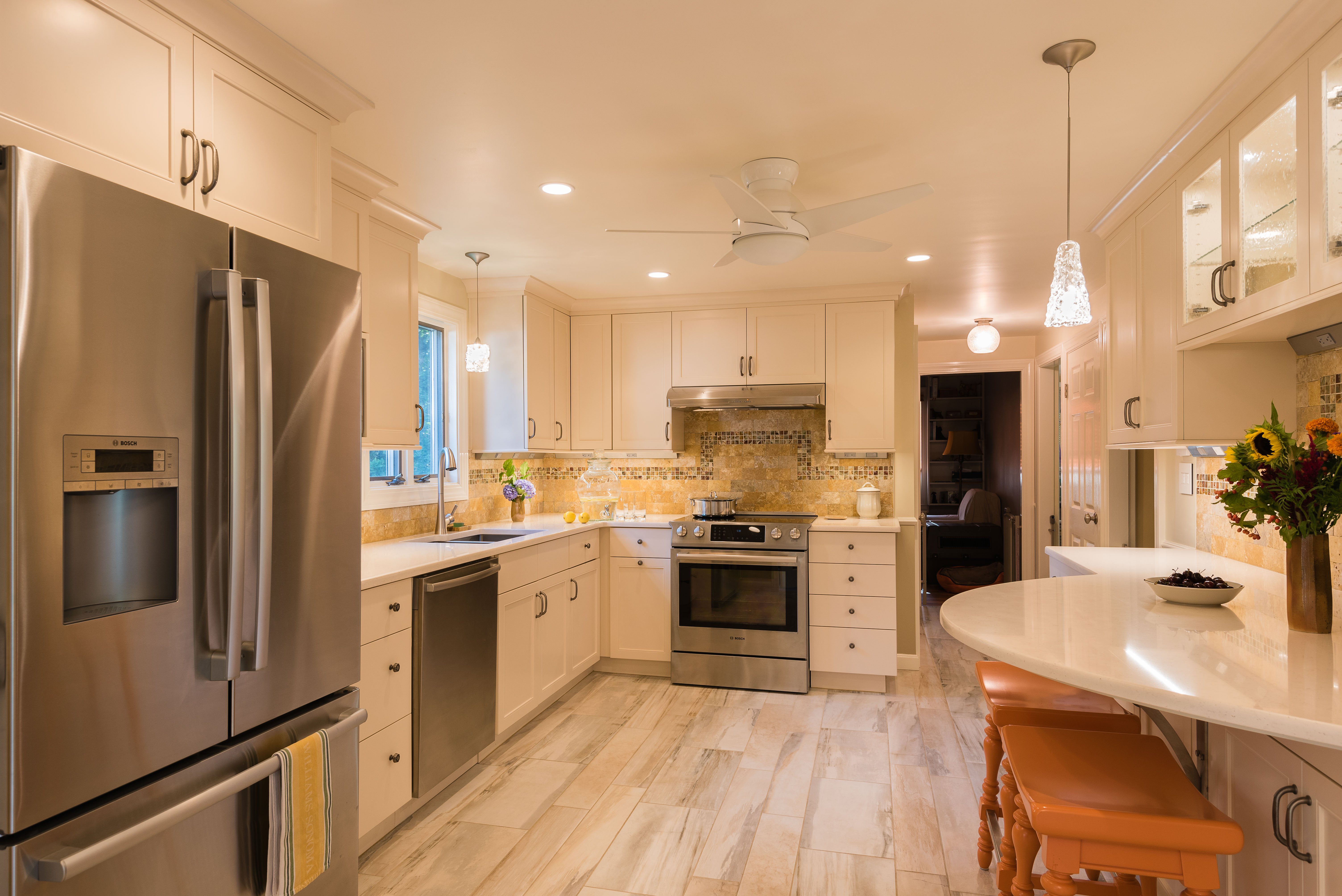
At RIKB, we use tile and stone for backsplashes in a number of the kitchens that we design. However, backsplash creativity has been ramped up several notches lately. Our clients are often thrilled when we help them make distinctive design statements with nontraditional backsplash materials.  Here are a few unique options for you to consider:

Paint: Using a contrasting paint color as a backsplash is a simple and extremely cost-effective option. Use a bold bright color that pops against the rest of the kitchen. We also play with different finishes, specifying glossy for the backsplash contrasted by a matte on the walls ceiling.

Chalkboard: It’s cost-effective and can add a lot of fun to your space. Write a recipe on the wall in front of your stove or cooktop, keep a running grocery list, to-do list or a simple inspirational quote!

Wood: Another cost-effective backsplash material that can exude an aura of warmth and a rustic feel. Often, we’ll recommend this when our clients have not opted for a wood or laminate floor. Wood offers a blank canvas and can be placed horizontally, vertically or in a zigzag pattern.

Wine corks: Oenophiles consider using wine corks as your backsplash. Using wine corks as the backsplash behind a wine refrigerator in your kitchen just shouts cool.

Wallpaper: Often times wallpaper as a backsplash material isn’t considered, but it can really set a kitchen apart. Make a bold statement with a bright patterned wall paper. Alternatively, use a simple stripe or polka dot paper for a more subtle look.

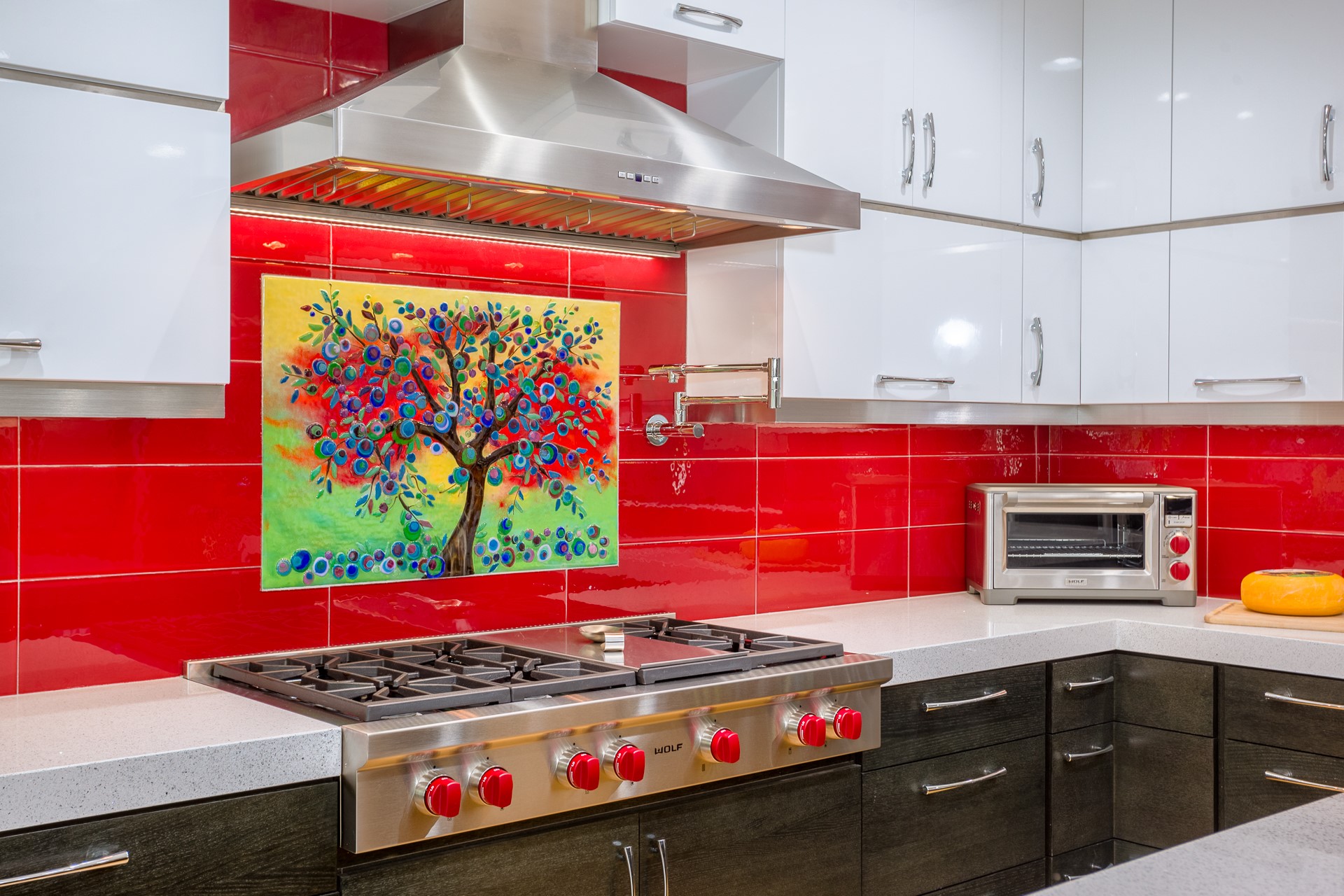
Artwork: Artwork won’t cover all of the backslash space, but using framed pictures is a creative, easy and cost-effective way to make a distinctive design statement.

Red Tree Artwork Backsplash

Buttons: Buttons are most appropriate for a mid-century modern or a vintage type of home. It’s a conversation starter and allows you to play with multiple colors. Best paired with neutral colored cabinets and countertops.

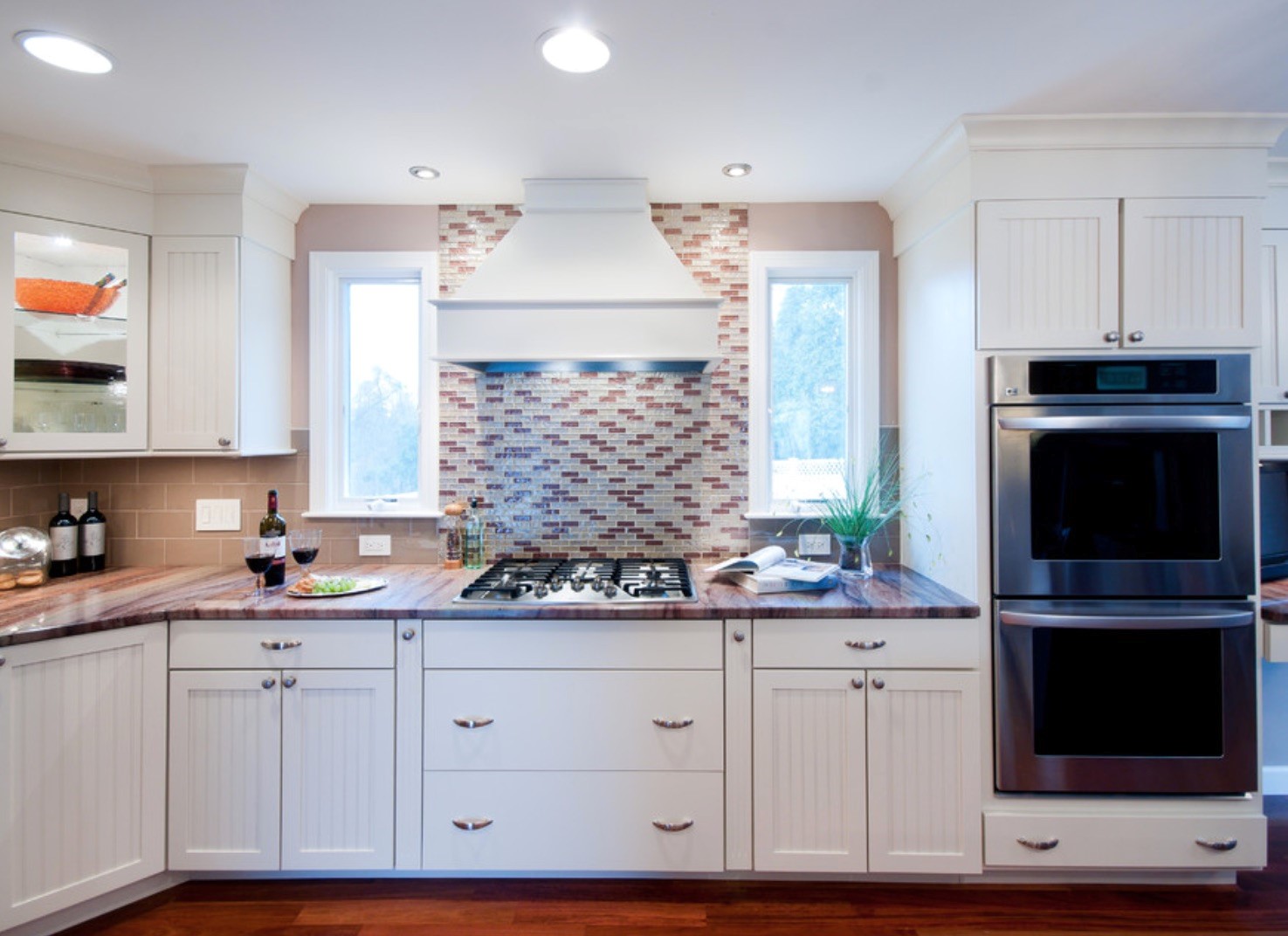
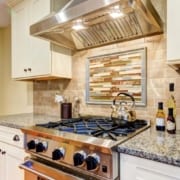
Beige Tile Stove Backsplash

These creative options help our clients consider alternatives to traditional tile and stone, which also remain very popular. Let us know if you would like us to help you explore different backsplashes for your new kitchen. Call our Design Center at 401-463-1550 or visit us at 139 Jefferson Boulevard, Warwick, RI.

At RI Kitchen & Bath, we know that remodeling your kitchen is a large investment. That’s why throughout our process we assist our clients in making sure they maintain the quality of their asset through effective and inspiring designs and specifying materials that stand the test of time.

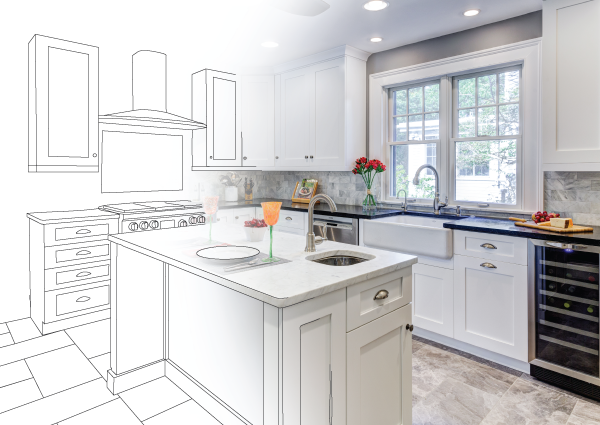
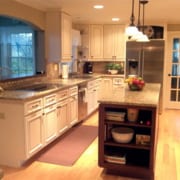
Remodeled kitchen with white cabinetry

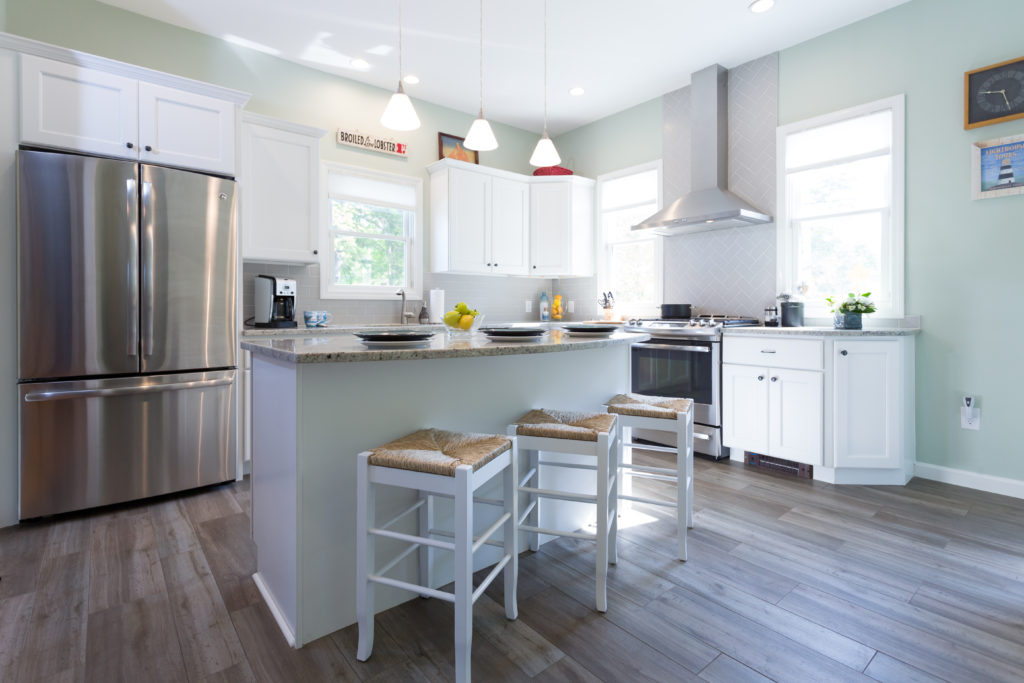
One option that is always a sure winner is white cabinetry. During the 1920s and 1930s, white was about the only option available for cabinetry, countertops, backsplashes and floor tile. Since then, times have changed, but white remains one of the most endearing and valuable palates for a kitchen renovation.

For both cabinets and appliances white tends to top the preference list annually. One of the reasons is that white represents happiness, innocence and purity according to color therapists. White also has the highest reflectiveness of any color, and as a result, can make even small kitchen feel spacious.

White is far from boring. Cabinet doors and trim create shadows and contrast layers that are architecturally interesting and provide depth. It makes every other color in the kitchen pop.

White cabinets in a kitchen are a classic look.

White cabinets can also be budget friendly. As a standard offering for almost every manufacturer, white cabinets can fit almost any budget and design motif whether your preference varies from euro contemporary to farmhouse traditional.

However, not everything in your kitchen should be white. We often capitalize on the blank canvas that white provides to incorporate splashes of color for wall and floor coverings and back splashes. Our clients find that incorporating color can make distinctive design statements that reflect their personality. Alternatively, white contrasts nicely with stainless steel appliances, wood flooring and wood countertops.

White appliances are also beginning to take market share from stainless steel. Manufacturers recognize the timelessness of white and are offering refrigerators, ovens, ranges, dishwashers, microwaves, etc. covered in polished enamel that gives the appearance of white glass.  Another popular option that many of our clients prefer is to cover appliances with panels that match their cabinet doors.

When our customers want white countertops, we often specify Carrara or Calacatta marble. In addition, every manufacturer of solid-surface and quartz-type of countertops offer numerous white options. You can even have white concrete if that is your preference.

An elegant kitchen with white cabinets and stainless appliances.

White remains a timely motif for any kitchen renovation. If you would like to see the many shades that white offers for your new kitchen, please visit our Design Center or give us a call at 401-463-1550.

Think of zone design as an expansion upon, rather than a replacement for, the classic work triangle approach to kitchen design and layout. It’s a practical (and increasingly popular) way to group kitchen activities together in appropriately organized spaces, allowing for multiple cooks and work centers.

Zoned Kitchen Design

The original model for this designates the zones as being very clear cut, with cleaning next to preparation, followed by cooking. Dishes are conveniently stored next to the cleaning area.

  • Consumables   (Food Storage)
  • Non-consumables  (Dishes, glassware, pots/pans)
  • Cleaning  (sink & dishwasher)
  • Preparation (counter space mostly, preparation utensils)
  • Cooking (cooktop, ovens and microwave)


Zoned Kitchen DesignThis new model changes things

Kitchens.com came up with a new model that is a bit more American and a bit less rigid by separating the cooking & baking areas. Designers in this country have been trained to separate cooking, which needs frequent monitoring, from the baking area, which requires little to no attention until the bell rings. Ovens are usually pushed to more remote areas of the kitchen. The new model also takes into account the importance of new technology/communication areas and eating spaces that should be taken into account in their own zones. While the work triangle focuses on the positioning of the range, refrigerator and sink, zone design addresses the full scope of appliances, plumbing fixtures and gadgets available to today’s homeowners. It also considers the many activities — entertaining, doing homework, charging cell phones and more — that occur in the kitchen, as well as the fact that kitchen size is growing and floor plans are more open to the rest of the home.

But don’t fret if you don’t have a kitchen large enough to house a distinct area for every activity: few people do. Prep, cooking and cleanup areas are the primary zones, and they’re mandatory. All other zones (baking, beverage and communication centers, for example) are not necessary and therefore called auxiliary zones. By combining some zones into one area or eliminating zones that don’t fit into your layout and lifestyle, you can make your kitchen multi-task just like you do.

Take a look at our Kitchen Design Portfolio to see the zone design in use!

While the basic functions of a kitchen – preparing and sharing meals – remain constant, the ways in which the room fulfills these requirements has changed dramatically. Today’s kitchens are a comfortable, high-tech center of activity for the entire family. The latest trends in kitchen design and construction are geared toward making kitchens more welcoming, more functional and capable of being more than just a place to cook Rhode Island Kitchen & Bath helps you to keep up with these evolving trends in order to create a kitchen design Massachusetts and Rhode Island customers will be able to enjoy as a family and among friends.

Some of the very latest trends and innovations in kitchen design include:

LED Lighting – Great lighting can make a great room, and the kitchen is no exception. Lighting fixtures using low-energy, long life LED lights are being used to spotlight key prep areas throughout the kitchen, as well as to provide flexible and energy-saving lighting for the entire room.

High Tech Appliances – Appliance makers have made great advances to help make the food storage and preparation process easier. “Smart” appliances allow you to schedule cook time, or to schedule a refrigerator defrost at the most opportune time, all while operating with reduced power demand.

Cabinet & Drawer Organizers – Reaching deep into the back of a cabinet to get to a container or plate is a thing of the past. New design in cabinet and drawer organizers are being built into today’s kitchens to maximize storage space and make it easy to access every item.

Connectivity – Today’s cookbooks and recipe boxes are likely to be stored on-line! Kitchens are keeping pace with internet connectivity, display screens and keyboards, wireless access and entertainment options like flat screen televisions and built-in sound systems.

Downsized Islands – The huge “chef’s island” that was a feature of many display kitchens over the past few decades is giving way to a more modest and functional island size. Instead of an island capable of seating an entire dinner party, kitchen designers are creating islands that require less space yet still offer prep areas and seating for a cozier gathering.

French Door Refrigerators – Long an upgrade favorite, French Door refrigerators are becoming more and more the “go to” for kitchen designers. Attractive to look at, and offering excellent flexible storage options, these split door designs are being found in more and more homes.

Recycling Options – Many new kitchens are expanding the trash compactor option to include space for recycling bins for paper and plastic products. Tastefully hidden behind cabinet facings, these spacious bins make it simpler and easier to be environmentally conscious.

Zoning – Kitchens designed around the way a homeowner prepares and serves meals are the highest form of function. Prep zones with easy access to appliances, storage and sinks are being set up with specifically designed lighting, surfaces and storage space. This might include a cluster of prep counter, small refrigerator, clean up sink and microwave oven – all within easy reach. The rest of the kitchen remains available for preparing larger meals, with full oven and range, full-size refrigerator and oversize sink for clean up.

Updated Cabinets – While traditional wood cabinets remain very popular, some homeowners are remodeling their kitchens with more unusual storage solutions, such as exotic woods, lots of glass and colorful finishes. Instead of white or stained wood, cabinets are painted in rich colors or dark finishes to complement new appliances and flooring options. New kitchen designs also add more display area into upper cabinets, putting in glass inserts into door fronts and gallery lighting inside the cabinet to show off their best china or collections of glassware.

Kitchen designers have been quick to adapt their ideas to meet the needs of the modern lifestyle. As a result, the kitchen has become an even more important room that is both functional and spacious.

Food Network Films On Location at RI Kitchen & Bath

RI Kitchen & Bath’s (RIKB) Design Center kitchen was the setting for the Food Network

Star Season 8 Finalist Michele Ragussis as she was filmed preparing various dishes using Hood® dairy products.

These segments were filmed on location at RIKB for upcoming “how-to” recipe videos that are now in production to be released on YouTube over the next several months.  It was exciting to watch Chef Michele work right here in RIKB’s very own kitchen, to see her create and incorporate the Hood products for seven delicious recipes ranging from appetizers to desserts.  We also got to sample them, and they looked very easy to make.

A film crew came to the Design Center in the morning to set up four cameras, lighting and sound equipment, transforming our kitchen area into a video recording studio.  Accessories were brought onto the set to give it a ‘feels like a home kitchen’ look.  By the end of the day, it was a “wrap” and all seven segments were complete.

According to the Food Network website, Michele lives in New York but fell in love with seafood and New England cuisine when she moved to Rhode Island for college.  For the past eight years, she’s worked as an executive chef in restaurants along the East Coast

RIKB is truly honored to have been a part of this production.  We would like to thank Chef Michele and Hood. Be sure to watch for these upcoming recipe videos on YouTube and let us know when you see them!

What’s the best way to light a kitchen?  While there is no one right answer, there are many mistakes made and misconceptions.

Recessed lights remain everyone’s favorite for general lighting.  They light the space evenly, while seeming to disappear from our line of sight.  While this is a great solution, it can be much more expensive than lighting with one or two surface mounted ceiling fixtures.

You need many more recessed lights to provide the same amount of lighting you would get with surface mounted fixtures.  Recessed cans are usually placed anywhere between 36” and 54” apart depending on the bulb (or lamp) used and the style of the trim.  But the ceiling may need to be re-plastered to run all the wiring.  A decorative fixture centered in the space can be a more cost effective option.

A good option for giving some task lighting for an island or peninsula is to use some hanging pendant lights or a gorgeous decorative chandelier.  These should be centered above the area to be lit and set  at approximately 30” above the countertop.

Remember, lighting can make or break a kitchen.  Most kitchens are under-lit.  Choose dimmers to reduce light levels.  Don’t skimp on the fixtures!

Keep an eye out for LED, it’s poised to take over the lighting world…

Next time:  under-cabinet lighting and more on how to avoid big mistakes with recessed lights.

So, you just can’t stand looking at that old, dark kitchen anymore…

But, where do you begin?

It seems so daunting at the beginning.  So much so that many people wait until something (the dishwasher, the faucet, and your patience) actually breaks before they decide to take the plunge and remodel.  There are many ways to install a project, but the best way to start is the usually same.

Pick up a Kitchen design magazine at the grocery store, buy a kitchen design book, and search the internet for photos of recently designed projects.  Start to get a feel for what you like and what you don’t.  What would feel right in your home?  What look will best express your personality?

Start to establish your budget.  Do you want to rip everything out or just give it a face-lift?  Is there a family heirloom that you want to design around?  Do you want to expand the space?

Now it’s time to bring in some help.  A trained kitchen designer can help you through the next phase and bring your dreams into reality.   Whether you are installing this yourselves or using a team of building professionals, everything needs to be planned out carefully ahead of time.  There is no reason for a project to drag out into the next calendar year.  You should only need to eat out for weeks, not months, if the planning is thorough.

BEFORE:

AFTER: